Urology · Uro-Oncology · Robotic Surgery · Focal Therapy
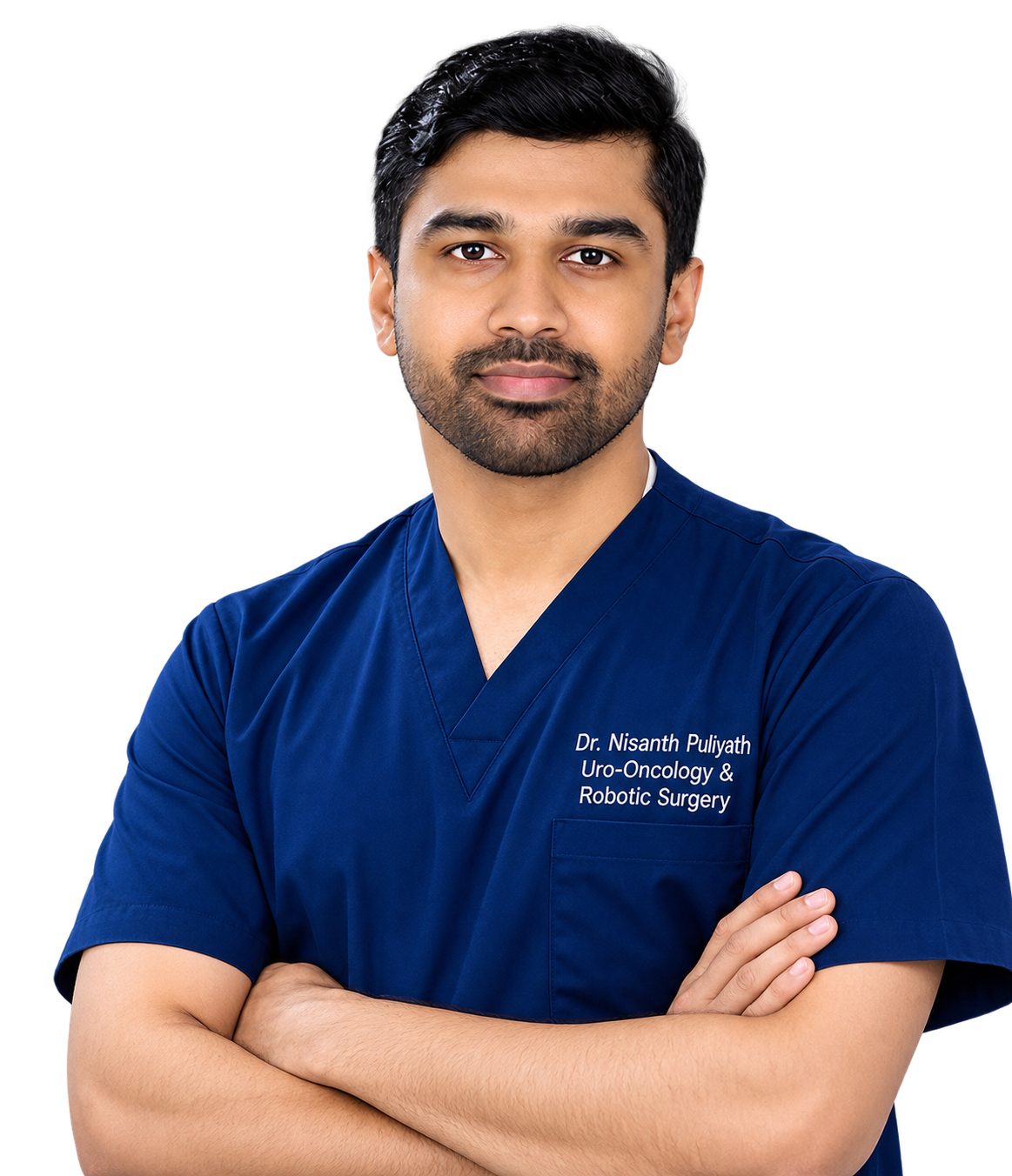
Dr. Nisanth PuliyathCancer surgery, explained clearly.
Robotic and focal treatment for prostate, kidney and bladder cancer in Kerala, India, with the reasoning behind every recommendation set out in language you can act on.
Dr. Nisanth PuliyathUro-Oncologist & Robotic Surgeon
About
A good operation starts with a decision you understand and agree with.
I am a urologist working in robotic uro-oncology, meaning minimally invasive surgery for cancers of the prostate, kidney and bladder, alongside focal therapy for men who are suitable for treatment targeted to the tumour rather than the whole gland.
I completed MBBS and MCh Urology at Government Medical College Kozhikode, with MS General Surgery at AIIMS in between. I then trained in robotic surgery and uro-oncology at Medanta, Gurugram, through the prestigious Vattikuti Fellowship. I also undertook visiting fellowships at international centres of excellence, including UC San Diego, AdventHealth Orlando and Johns Hopkins, USA, where I trained in robotic uro-oncology and focal therapy alongside pioneering surgeons.
I now offer these treatments here in Kerala: robotic urological cancer surgery, including nerve-sparing robotic prostatectomy; focal therapy, including NanoKnife (IRE) for suitable men; and MRI-fusion and transperineal prostate biopsy. This site exists so you can arrive at a consultation already knowing what your diagnosis means and which questions matter.
Conditions & treatments
What I treat, and how.
Each card opens a plain-language explanation: what the condition is, how it is assessed, and what treatment actually involves. Tap any one to read more.
Most common · Uro-oncology
Prostate cancer
Robotic radical prostatectomy with nerve-sparing technique, plus surveillance and focal options for suitable disease.
Read more →
Uro-oncology
Kidney cancer
Robotic partial nephrectomy to remove the tumour and keep the kidney, or radical surgery for larger tumours.
Read more →
Uro-oncology
Bladder cancer
From TURBT and BCG for early disease through to robotic cystectomy with urinary reconstruction.
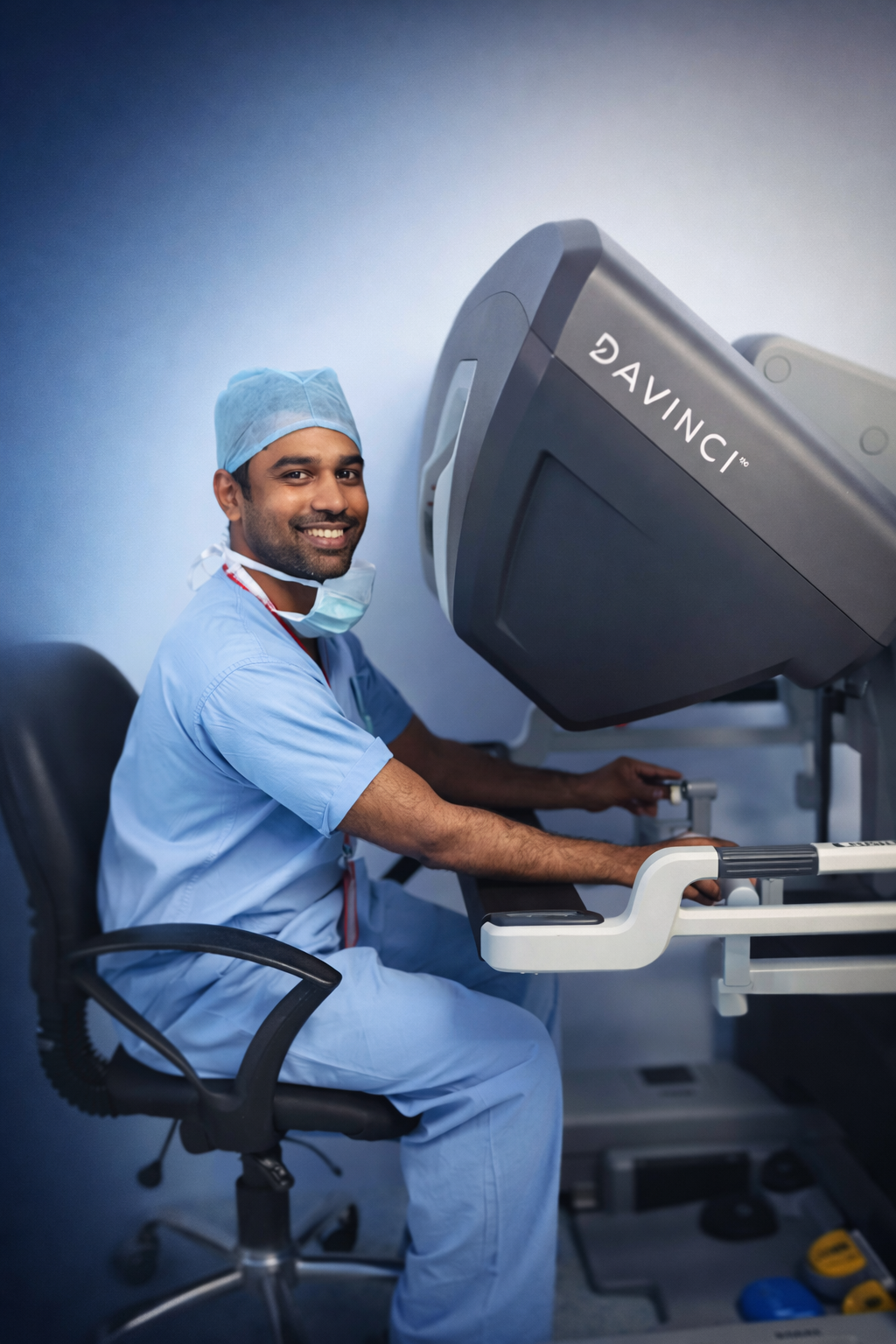
It is an instrument, not an autonomous system. Every movement comes from my hands at a console a few feet from the table. What it adds is vision, reach and steadiness inside spaces where millimetres decide the result.
Vision
Ten times magnified, in 3D
The console gives a stereoscopic view magnified up to tenfold. Nerve bundles and vessels that are hard to define through an open incision become distinct structures you can work around deliberately.
Control
Wristed instruments, no tremor
The instruments rotate further than a human wrist, and the system filters out tremor. That matters most during nerve-sparing dissection and when reconstructing the urinary tract afterwards.
Recovery
Keyhole access, earlier discharge
Four to five small incisions instead of one long one means less blood loss and less pain. Most patients are walking the next day and home within a few days, without trading away cancer control.
Videos
Explained on camera.
Short talks on the conditions and procedures I treat, for patients and families who would rather watch than read.
Foresight is an educational calculator that estimates outcomes of robotic radical prostatectomy from your own biopsy and MRI findings, built on published prediction models. It does not replace a consultation, but it can help you prepare for one.
A new diagnosis, a second opinion, or a question about a procedure you have been offered: all are welcome. Email is the most reliable way to reach me, and I reply as soon as clinical work allows.
Please read
This website is for education only. It is not medical advice and does not create a doctor–patient relationship. If this is an emergency, go to your nearest hospital or call 112.
Urology · uro-oncology · robotic surgery · focal therapy
Prostate cancer
What it is
A cancer arising in the prostate, the gland that sits below the bladder and produces part of the seminal fluid. It is the most common cancer in men over 50, and among the most treatable when it is found while still confined to the gland.
How it is assessed
A PSA blood test is usually the first step. If it is raised, an MRI comes next, and a targeted biopsy only if the MRI shows something suspicious. The biopsy gives a Gleason score and grade group; the MRI and, where needed, a PSMA PET scan give the stage.
Treatment options
Active surveillance: for low-risk disease. Monitoring with PSA, MRI and repeat biopsy, treating only if the cancer behaves differently than expected.
Robotic radical prostatectomy: removal of the whole prostate through keyhole incisions, with nerve-sparing where the cancer allows, to protect continence and erectile function.
Radiation therapy: equally effective for many men, with a different side-effect profile.
Focal therapy: treating only the part of the gland containing the tumour, in carefully selected cases.
Grade, stage and your own priorities all shape this decision. There is rarely only one correct answer, so ask for the trade-offs of each option in your specific case.
Focal therapy: HIFU, cryotherapy and NanoKnife (IRE)
The idea
In selected men, prostate cancer is confined to one part of the gland. Focal therapy destroys that area and leaves the rest of the prostate intact. It sits between surveillance and removing or irradiating the whole gland.
How it is done
HIFU uses focused ultrasound energy to heat and destroy the target tissue, delivered through a probe in the rectum.
Cryotherapy destroys the same tissue by controlled freezing through fine needles.
NanoKnife (irreversible electroporation) uses short electrical pulses between fine needles to break down the tumour cells, without heating or freezing. Because it is non-thermal, nearby nerves, the urethra and the sphincter are less likely to be affected, which makes it useful for tumours close to those structures.
Both are day-case or short-stay procedures done under anaesthesia, with no surgical incision.
Who it suits
It depends on accurate mapping: a good quality MRI and, usually, a transperineal or fusion biopsy showing disease in one region only. It is not appropriate for high-risk or widespread cancer, and it commits you to close follow-up afterwards, since the untreated prostate remains.
Focal therapy remains uncommon in this part of India. If you are considering it, ask specifically about patient selection criteria and the follow-up protocol, because those matter as much as the technology.
Kidney cancer
What it is
Renal cell carcinoma is the commonest type, arising from the lining of the kidney tubules. Most cases today are found by chance on a scan done for something else, before any symptoms appear.
Warning signs
The classical triad of blood in the urine, flank pain and a palpable mass is now rare, and usually indicates advanced disease. Most patients feel entirely well.
Treatment
Robotic partial nephrectomy: for smaller tumours, only the tumour is removed and the kidney is preserved. Cancer outcomes match radical surgery while protecting long-term kidney function.
Robotic radical nephrectomy: for larger or centrally placed tumours. Most people live normally with one kidney.
Surveillance or ablation: considered for very small tumours, particularly in older or frail patients.
If you have been told your kidney must be removed, it is reasonable to ask whether a partial nephrectomy has been considered and why it was ruled out.
Bladder cancer
The symptom that matters
Painless blood in the urine is the classic sign. A single episode that clears up on its own still needs investigating, because that is the point at which the disease is most treatable.
Two very different diseases
Non-muscle-invasive: confined to the inner lining. Treated by endoscopic resection (TURBT), often followed by BCG or chemotherapy instilled into the bladder, then regular cystoscopic follow-up.
Muscle-invasive: growing into the bladder wall. Usually requires chemotherapy followed by radical cystectomy, increasingly performed robotically, or a bladder-preserving protocol in selected cases.
After cystectomy
Urine has to be rerouted, either into an ileal conduit with a stoma bag or a neobladder reconstructed from bowel. Which suits you depends on the tumour, kidney function and how you want to live afterwards, and it is worth discussing in detail before surgery.
Follow-up cystoscopy is not optional in bladder cancer. Recurrence is common and almost always manageable when caught early.
MRI-fusion and transperineal biopsy
Why the method matters
An older-style random biopsy samples the prostate blindly and can miss significant cancer or find insignificant disease. Fusion biopsy overlays your MRI onto live ultrasound so the needle goes to the lesion the radiologist actually flagged.
Transperineal access
The needle passes through the skin between the scrotum and anus rather than through the rectal wall. This substantially reduces the risk of serious infection and gives better access to the front of the gland, where tumours are otherwise easy to miss.
What to expect
It is usually a day procedure under sedation or general anaesthesia. Blood in the urine or semen for a few weeks afterwards is expected and settles on its own.
If a biopsy has been recommended, ask whether an MRI has been done first and whether the biopsy will be targeted. The sequence changes what the result can tell you.
Testicular and penile cancer
Testicular cancer
The commonest solid tumour in men aged roughly 15 to 35, and one of the most curable cancers in medicine even when it has spread. A painless lump or firmness in one testis needs an ultrasound scan promptly, not a wait-and-see approach.
Treatment begins with removal of the affected testis, which is both diagnostic and therapeutic. What follows (surveillance, chemotherapy, or retroperitoneal node surgery) depends on the type and stage. Sperm banking should be discussed before chemotherapy.
Penile cancer
Uncommon, usually a squamous cell carcinoma. Any sore, lump or growth that has not healed within about four weeks should be biopsied rather than treated repeatedly with creams.
Where it is oncologically safe, penile-preserving surgery is preferred. Management of the groin lymph nodes has a large effect on survival and is decided by the risk profile of the tumour.
Both cancers are strongly time-sensitive. Delay, rather than the disease itself, is often what changes the outcome.
BPH (enlarged prostate)
What it is
Benign prostatic hyperplasia is non-cancerous enlargement of the prostate, affecting most men to some degree with age. It is not cancer and does not turn into cancer.
Symptoms
A slow stream, hesitancy before starting, waking at night to pass urine, urgency, and a sense of not emptying fully.
Treatment
Lifestyle: reducing caffeine and late-evening fluids, and bladder training, help mild symptoms.
Medication: alpha-blockers relax the prostate within days; 5-alpha-reductase inhibitors shrink it over months.
Surgery: TURP remains the benchmark, with laser techniques such as HoLEP offering less bleeding and shorter catheter times.
Surgery becomes the right answer when medication stops working or complications appear: retention, recurrent infection, stones, or pressure on the kidneys.
Stones and laser surgery
Options
Conservative management: many small ureteric stones pass on their own with fluids, analgesia and medical expulsive therapy.
Ureteroscopy and RIRS: a flexible scope passed through the natural urinary tract, with a laser used to fragment the stone. No incision.
PCNL: for large or staghorn stones, through a small track in the flank.
Preventing the next one
Recurrence is common and largely preventable. Stone analysis and a metabolic evaluation identify why the stone formed, which turns treatment into a plan rather than a repeated procedure.
If you have had more than one stone, ask for the stone to be analysed and for a metabolic work-up. It changes what you should be doing daily.
Kidney transplant surgery
Why a transplant
For most people with kidney failure, a transplant offers a longer life and a freer one than remaining on dialysis. It is an operation on two people at once when the donor is living, so the assessment is as important as the surgery.
What is involved
Live donor transplant: a healthy relative or approved donor gives one kidney. The donor kidney is removed laparoscopically or robotically, which means a shorter recovery for the donor.
Deceased donor transplant: allocation through the state registry, with waiting time depending on blood group and matching.
Work-up: tissue typing, cross-match, cardiac and infection screening, and legal clearance for donation.
Afterwards
The new kidney usually starts working within days. Lifelong immunosuppression is needed, with regular blood tests to balance rejection risk against infection risk.
Ask about donor safety data, expected waiting time for your blood group, and what the medication will cost each month. These shape the decision as much as the surgery does.
Adrenal surgery
Why the adrenal gland matters
The adrenal glands sit above each kidney and produce hormones that control blood pressure, salt balance and the stress response. A tumour there may be silent and found incidentally on a scan, or it may announce itself through hormone effects.
When surgery is advised
Functioning tumours: those producing excess hormone, such as phaeochromocytoma, aldosterone-producing adenoma or cortisol-producing adenoma. Removing them can resolve blood pressure or metabolic problems.
Size or growth: larger tumours, or those growing on follow-up scans, are removed because of cancer risk.
Suspected malignancy: adrenal cancer, or a deposit from a cancer elsewhere.
How it is done
Most adrenalectomies are performed laparoscopically or robotically through small incisions, usually with an overnight or two-night stay. Hormone-producing tumours need careful preparation with medication beforehand, and close monitoring of blood pressure during surgery.
If a scan has found an adrenal nodule, the first step is hormone testing, not surgery. Ask which hormone tests have been done before any operation is planned.